Lab notebooks across skin and tissue research are filling up with one name lately: GHK-Cu. If you’ve spent any time reading about collagen studies, you’ve probably run into this peptide more than once.
But what actually makes it worth a researcher’s attention? And why does purity and quantity matter so much when working with it? Let’s break it down and understand why GHK cu 50mg is in the highlights.
What is GHK-Cu Peptide?
GHK-Cu peptide is a small, naturally occurring molecule made of three amino acids bound to a copper ion. The GHK part stands for the amino acid sequence glycine, histidine, and lysine. The “Cu” is simply the chemical symbol for copper.
This compound isn’t something scientists invented in a lab from scratch. It occurs naturally in the human body, though levels tend to drop by 60% between the ages of 20 and 60 (from 200 ng/mL to 80 ng/mL) as people age. That’s part of why researchers got curious about it in the first place.
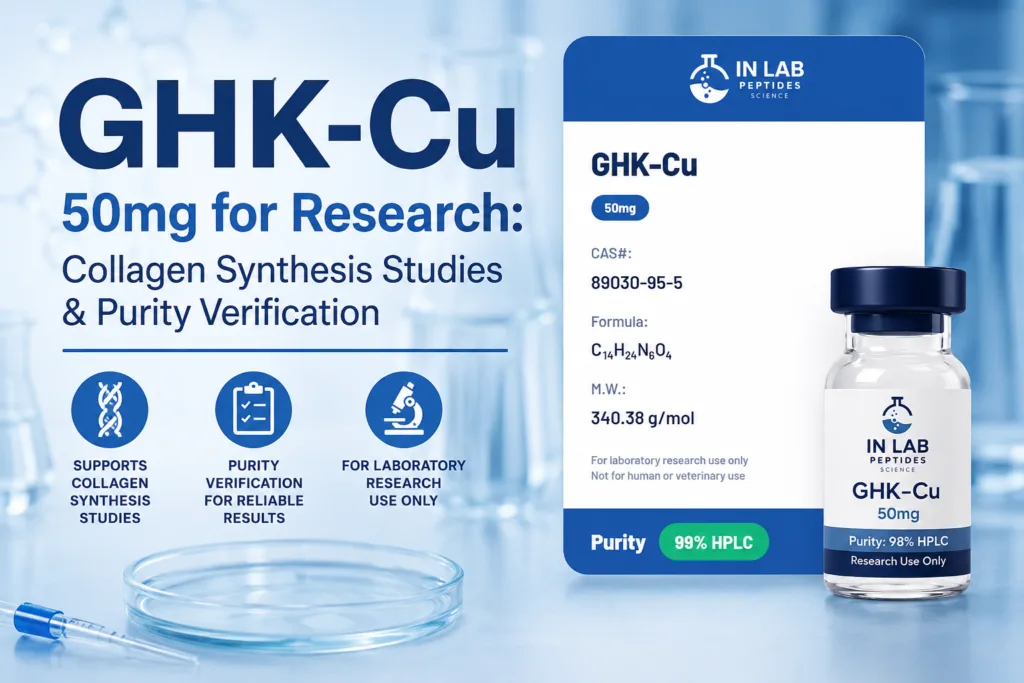
When it comes to lab work, GHK Cu 50mg is a common format you’ll see listed by suppliers. The 50mg size gives researchers a manageable amount to reconstitute and measure out for experiments, without wasting material on smaller practical doses.
Molecular Structure & Properties
Here’s a quick snapshot of what this peptide looks like on paper:
Property | Detail |
Molecular Formula | C14H22N6O4Cu |
Molecular Weight | Roughly 340 g/mol |
Appearance | Blue or violet powder (freeze-dried) |
Solubility | Dissolves in water |
Common Research Format | GHK Cu 50mg vials |
Knowing these basics helps researchers handle the compound correctly and understand what they’re working with before any study even begins.
GHK-Cu & Collagen Synthesis Studies
Collagen is the protein that gives skin and connective tissue their structure. As we get older, the body produces less of it, which is one reason researchers keep circling back to this peptide.
Studies involving the GHK cu peptide glance at how it interacts with skin cells and connective tissue. Some research has focused on its possible role in signaling cells to produce more collagen, while other studies examine its effect on the surrounding tissue matrix.
Role in Extracellular Matrix Research
The extracellular matrix is basically the scaffolding that holds cells together. Researchers studying copper peptide GHK-Cu usually look at how it might influence this scaffolding, particularly in models that mimic skin aging or tissue damage.
Relevance to Wound Healing & Tissue Repair Models
Wound healing research is another area where this peptide shows up frequently. Lab models simulating tissue repair sometimes use GHK-Cu to observe how cells respond during the healing process. It’s worth noting this work is done in controlled lab settings, not as a treatment recommendation.
GHK-Cu Topical Research Applications
All research uses the same form of this compound. Some studies focus on GHK-Cu topical formulations, which are applied to skin models or tissue samples directly. Others use a reconstituted solution for cell culture work.
Topical vs. Solution-Based Research Use
Format | Common Research Use | Key Consideration |
Topical formulation | Skin and dermal layer studies | Absorption can vary by sample |
Reconstituted solution | Cell culture experiments | Needs sterile handling |
Lyophilized powder (50mg) | Storage and custom dilution | Must stay stable before mixing |
Each format serves a different purpose, so the choice usually comes down to what the study is actually trying to measure.
Why Purity Verification Matters in GHK-Cu Research?
Here’s something that doesn’t get talked about enough: A peptide is only as useful as its purity. If a sample is contaminated or poorly synthesized, the results of a study can be skewed or simply unreliable. That’s a problem nobody wants after weeks of careful work.
Common Purity Testing Methods
Labs typically rely on a few trusted methods to confirm purity:
- HPLC (High-Performance Liquid Chromatography) separates compounds to check for contaminants.
- Mass spectrometry confirms the molecular weight matches what’s expected.
- Certificate of Analysis (COA); a document supplied by the manufacturer showing test results.
How to Read a Certificate of Analysis?
A proper COA should list the purity percentage, batch number, date of testing, and the name of the testing lab. That’s a red flag worth taking seriously if any of these are missing.
Sourcing GHK-Cu 50mg for Lab Use
Every supplier has a different quality. When sourcing GHK Cu 50mg, look for vendors who provide third-party testing and a clear COA for every batch. Vague labeling or missing documentation usually means it’s best to look elsewhere.
Storage & Stability Best Practices
Lyophilized (freeze-dried) peptide should be stored in a cool and dry place away from light. Once reconstituted, it generally needs refrigeration and should be used within a reasonable timeframe to avoid degradation. Stability directly affects how reliable any study results will be.
Key Considerations before Using GHK-Cu in Research SettingsThis compound is intended strictly for laboratory and research purposes. It is not meant for human or animal consumption, and any handling should follow your institution’s safety and chemical handling protocols. |
In Closing,
GHK-Cu continues to draw attention in collagen and tissue research, but the real value of any study depends on the quality of the peptide being used. Purity verification isn’t a box to tick; it’s the foundation of trustworthy results.
If you’re sourcing material for your next study, take the time to review the COA, confirm third-party testing, and choose a supplier who’s transparent about their process. Your data will only be as solid as the compound behind it!
FAQs
What is GHK-Cu 50mg used for in research?
It’s primarily studied in connection with collagen production, tissue repair, and extracellular matrix behavior in lab settings.
Is GHK-Cu the same as copper peptide GHK-Cu?
Yes, these terms refer to the same compound. The naming just varies depending on the source or supplier.
How is GHK-Cu purity tested?
Most labs use HPLC and mass spectrometry, then back it up with a Certificate of Analysis from the supplier.
Can GHK-Cu topical formulations be used in skin studies?
Yes, topical formulations are commonly used in dermal and skin-layer research models.
How should GHK-Cu 50mg be stored?
Keep the lyophilized powder cool and dark. After reconstitution, refrigerate it and use it within the recommended window.