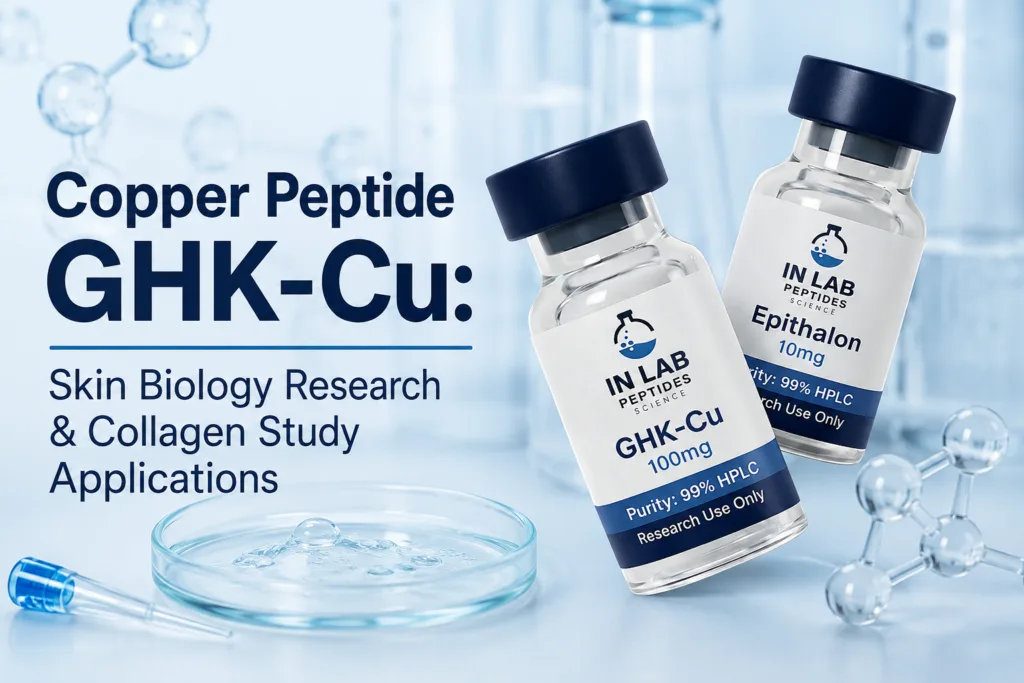
Ever wonder why one tiny molecule, something your own body already makes, ended up sitting on so many lab benches around the world? That’s the story behind GHK-Cu. This little copper-binding tripeptide was first noticed by scientists more than fifty years ago, and it never really left the research spotlight. Labs studying collagen activity, fibroblast behavior, and tissue remodeling keep circling back to copper peptide GHK-Cu because of how it behaves once it interacts with cells.
At InLab Peptides, we supply lab-grade GHK-Cu so researchers can keep that work going, with every vial sold strictly for research use and backed by third-party testing. Here’s a closer look at what the GHK copper peptide actually is, why skin biology researchers keep studying it, and what the current science says about its role in collagen-related research.
GHK-Cu is short for Glycyl-L-Histidyl-L-Lysine bound to a copper ion. Most people skip the long name and just call it GHK-Cu, or the GHK copper peptide. It was first identified in human plasma back in the 1970s, and one thing stood out immediately: this tiny peptide grabs onto copper and holds it tightly. That copper isn’t just along for the ride. It plays a real role in how the molecule behaves once it’s inside a biological system, especially around enzyme activity and cell signaling.
Because this peptide occurs naturally in the body, researchers had something to compare it against from day one. That’s part of why it shows up so frequently in skin biology papers. There’s already a biological baseline to measure new findings against, which makes the research easier to interpret.
|
Property |
Detail |
|
CAS Number |
89030-95-5 |
|
Molecular Formula |
C14H24N6O4 |
|
Molecular Weight |
340.38 g/mol |
|
Structure Type |
Copper-binding tripeptide |
|
Typical Research Grade |
99% HPLC purity |
Every batch of GHK-Cu from InLab Peptides comes with a Certificate of Analysis. This certificate shows what’s in the vial, so researchers know exactly what to expect before starting their tests.
A lot of the interest in this molecule comes down to one question: How does it talk to cells? Researchers studying the GHK Cu peptide have looked closely at fibroblasts, oxidative stress markers, and the signaling chains that control tissue remodeling. None of this is settled science with one clean answer, but the patterns researchers keep finding are why the compound stays popular in lab settings.
Fibroblasts are the cells responsible for producing structural proteins in skin tissue, and they’ve been a major focus in GHK-Cu studies. In controlled lab models, researchers have observed changes in fibroblast behavior when these cells are exposed to the peptide, including shifts in signaling activity tied to tissue structure. That’s exactly why so many in-vitro experiments use fibroblast cultures as their starting point when studying this compound.
Oxidative stress is another angle researchers keep coming back to. Some lab studies have looked at how GHK-Cu interacts with antioxidant pathways, since copper itself is involved in several enzyme systems related to oxidative balance. Add in its connection to tissue remodeling signals, and you can see why this peptide keeps appearing in papers focused on cellular repair processes rather than just basic biochemistry. GHK-Cu accelerates wound healing in skin, hair follicles, gastrointestinal tract, and bony tissue across multiple animal models, including rats, mice, pigs, and dogs.
This is where copper peptide GHK-Cu gets the most attention. Collagen is the structural protein that gives skin tissue its strength, and a good chunk of the published research on this peptide centers on collagen-related signaling pathways. Researchers aren’t claiming a finished story here. They’re mapping out how this peptide might influence the genes and proteins tied to collagen production, one study at a time.
Skin biology labs tend to study a handful of overlapping areas when GHK-Cu is involved, since collagen activity rarely happens in isolation.
|
Research Area |
What’s Being Studied |
|
Collagen-related expression |
Gene and protein signaling tied to collagen pathways |
|
Fibroblast proliferation |
Cell response patterns in controlled lab models |
|
Tissue remodeling |
Signaling activity in wound-model research |
|
Antioxidant activity |
Oxidative stress response observed in vitro |
When researchers order GHK-Cu for their work, they mainly want one thing: a compound they can rely on to act the same way every time, no matter the batch.
A fair number of published studies test GHK-Cu using topical models, meaning the compound is applied directly to skin tissue samples or animal models rather than studied purely in a cell culture dish.
This is where GHK-Cu topical research differs from straightforward fibroblast studies, since it adds questions about absorption, formulation, and how the peptide behaves once it crosses tissue layers.
Topical research models give scientists a way to study how GHK-Cu interacts with tissue structure as a whole, not just isolated cells. Some studies have looked at carrier formulations, concentration levels, and how the peptide distributes across tissue layers in animal or ex vivo skin models. A clinical trial showed that using GHK-Cu on the skin every day for three months led to an average 28% increase in collagen, which makes up 70% of our skin. The top 25% of participants saw a 51% increase. None of this translates into instructions for personal use; it’s strictly about understanding the mechanism within a controlled research setting.
Researchers running topical studies usually need to control for a long list of variables, including tissue type, exposure time, and how the formulation itself is prepared. GHK-Cu topical experiments tend to require more setup than basic cell culture work, which is part of why labs lean on highly pure, well-documented compounds to keep results reliable.
It helps to see where the GHK copper peptide fits next to other commonly studied research compounds, since labs run comparative work across multiple peptides.
|
Peptide |
Primary Research Focus |
Mechanism Class |
|
GHK-Cu |
Skin biology, collagen pathway signaling |
Copper-binding tripeptide |
|
BPC-157 |
Tissue repair research |
Stable gastric-derived peptide |
|
KLOW |
Combined regenerative pathway research |
Multi-peptide blend |
Different compounds are studied for various reasons, but GHK-Cu is special because it is linked to copper biology. This connection sets it apart from other peptides that do not have a metal-binding component.
None of this research means anything if the compound itself isn’t reliable. That’s the entire reason InLab Peptides runs its GHK-Cu production through a cGMP-compliant facility, with every batch tested by an independent lab before it ships. Purity issues, even small ones, can throw off an entire study, so researchers tend to be picky about sourcing for good reason.
HPLC testing confirms a compound’s purity at a level that basic visual inspection simply can’t match. Pair that with a Certificate of Analysis, and researchers get a documented paper trail showing exactly what they’re working with, batch by batch. For anyone running peer-reviewed or grant-funded research, that documentation is the baseline.
GHK-Cu typically ships in a lyophilized, or freeze-dried, form to keep it stable during transit and storage. Before use, it needs proper reconstitution following standard lab protocols, and once mixed, it should be stored according to the compound’s specific stability guidelines, usually refrigerated and shielded from light. Improper storage is one of the most common reasons research compounds lose potency before a study even begins, so this step matters more than people expect.
Copper peptide GHK-Cu has established itself in skin biology research through many years of studies. Researchers have focused on how it affects collagen production, signals in skin cells called fibroblasts, and its antioxidant properties. It’s not a finished story, and it’s not meant for anything beyond controlled lab work, but that’s exactly what makes it worth studying further.
If you’re running research that calls for a reliable, well-documented GHK-Cu compound, InLab Peptides has you covered with 99% HPLC-verified batches and full COA documentation on every order. Browse the GHK-Cu listing on InLab Peptides today & get your next research batch shipped fast, with the paperwork to back it up.
What is copper peptide GHK-Cu used for in research?
It’s primarily studied in skin biology research, with a focus on fibroblast activity, collagen-related signaling, and antioxidant pathways in controlled lab settings.
Is the GHK cu peptide the same as standard GHK?
Not exactly. GHK-Cu is the copper-bound version of the GHK peptide, and that copper component changes how the molecule behaves in biological systems compared to GHK alone.
Is GHK-Cu topical application common in published studies?
Yes, many studies use topical or ex vivo skin models to examine how the peptide behaves across tissue layers, separate from basic cell culture research.
What purity level should researchers look for?
Most published research relies on compounds tested at 99% HPLC purity or higher, paired with a verifiable Certificate of Analysis.
How should GHK-Cu be stored before use?
In its lyophilized form, it should be kept cool and away from light. Once reconstituted, refrigeration and proper handling become even more important to preserve stability.

This website offers products strictly for Laboratory Research Use Only. Not for human consumption, medical, or veterinary use.